Firenetting: a new airborne defense layer against wildfire embers.
From patented concept to engineering validation, prototype development, controlled testing,
agency-observed field demonstration, and commercialization pathway.
FRED: First Responder Ember DroneUS Patent No. 12,539,435 B2Inventor: Bradley Lawrence BartzPatent issued Feb. 3, 2026+1-310-373-3169
Firenetting proposes a patented airborne ember-interception system using UAV-controlled
fire-resistant mesh netting to capture or slow windborne wildfire embers before they land
and ignite new fuel. This white paper defines the wildfire ember problem, summarizes the
FRED First Responder Ember Drone concept, identifies early deployment scenarios, and proposes
a staged engineering, prototype, testing, and field-demonstration pathway.
The purpose of this paper is not to claim that Firenetting is a finished fire-service product.
The purpose is to define a responsible path from issued patent to measurable engineering evidence.
Executive summary
The next step is not invention. The next step is engineering validation.
Firenetting proposes a new airborne defense layer against one of the most dangerous
mechanisms of wildfire spread: windborne embers. Embers can travel ahead of the visible
flame front, cross firebreaks, jump roadways, land on receptive fuels, and ignite new
fires before conventional suppression resources can respond.
Firenetting’s proposed response is direct: intercept embers while they are still airborne.
FRED, the First Responder Ember Drone, is a patented UAV-controlled fire-resistant mesh
netting system designed to position airborne netting between ember sources and vulnerable
targets.
Development status: Firenetting is currently a patented concept seeking prototype
funding, engineering validation, controlled testing, and field demonstration partners.
This white paper is designed for grant reviewers, strategic investors, wildfire researchers,
drone-platform partners, insurers, utilities, emergency managers, and public-safety agencies.
The invention is protected by U.S. Patent No. 12,539,435 B2,
titled “Unmanned Aerial Vehicle (UAV) Controlled Netting System and Method Thereof.”
The patent establishes the protected concept. The purpose of this white paper is to describe
the responsible next step: build, test, measure, and determine where the technology can be
safely and effectively deployed.
PatentIssued
PrototypeSeeking funding
TestingNeeds partners
GoalEvidence-based deployment path
The problem
Windborne embers defeat ordinary boundaries.
Wildfire defense often focuses on the visible fire line. That is necessary, but incomplete.
In wind-driven fires, the visible flames are not the only threat. Embers lifted by wind can
move ahead of the main fire, land on dry vegetation or vulnerable structures, and create new
ignition points.
Roads, firebreaks, defensible space, and structure hardening all matter. But each of them
is challenged by embers. A road can slow flames but still be crossed by burning material in
the air. A cleared space can reduce local fuel but not prevent embers from landing on roofs,
decks, vents, palm crowns, fences, gutters, or ornamental vegetation. A hardened structure
still faces risk if ember exposure is heavy enough or if weak points exist.
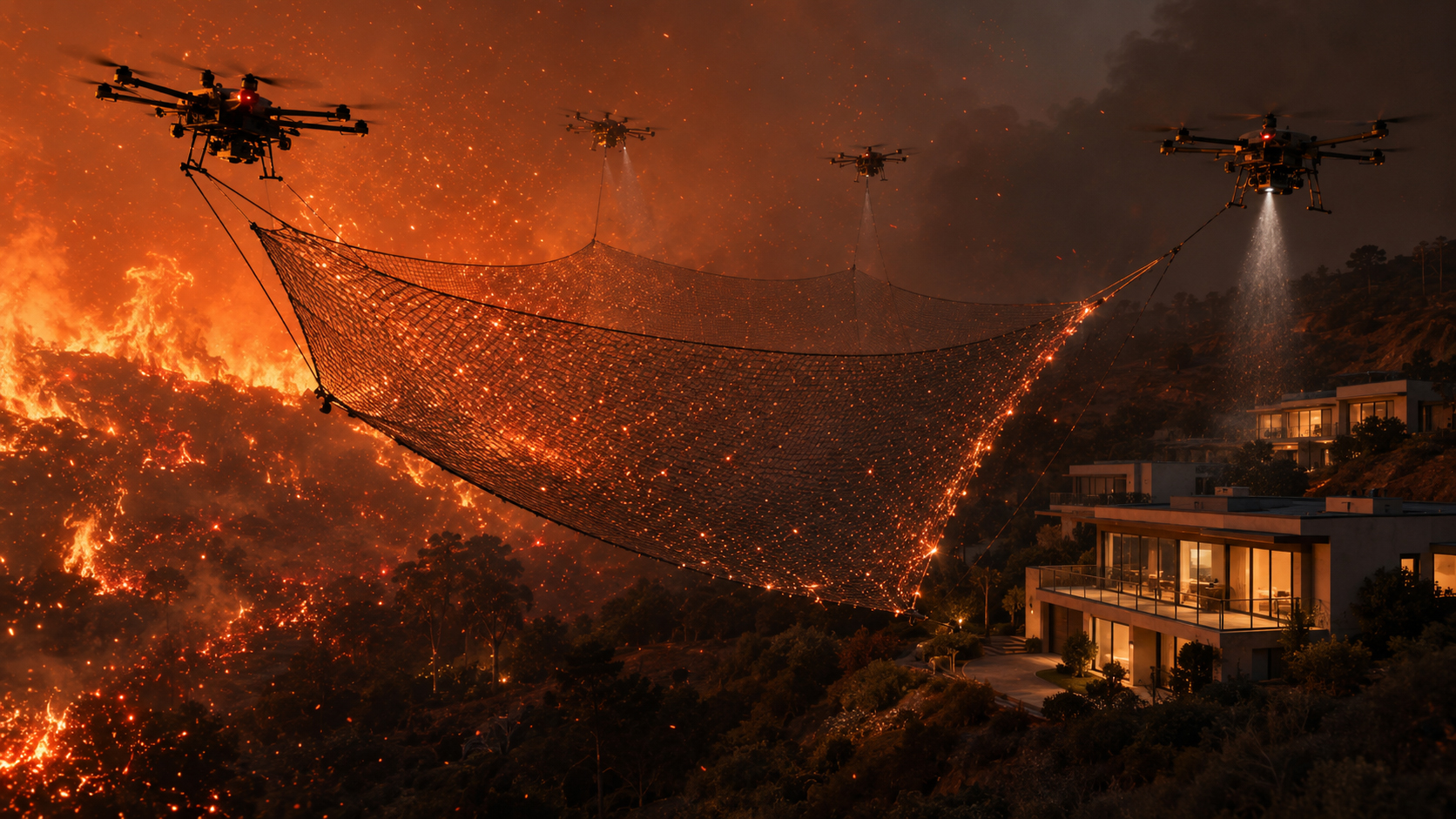
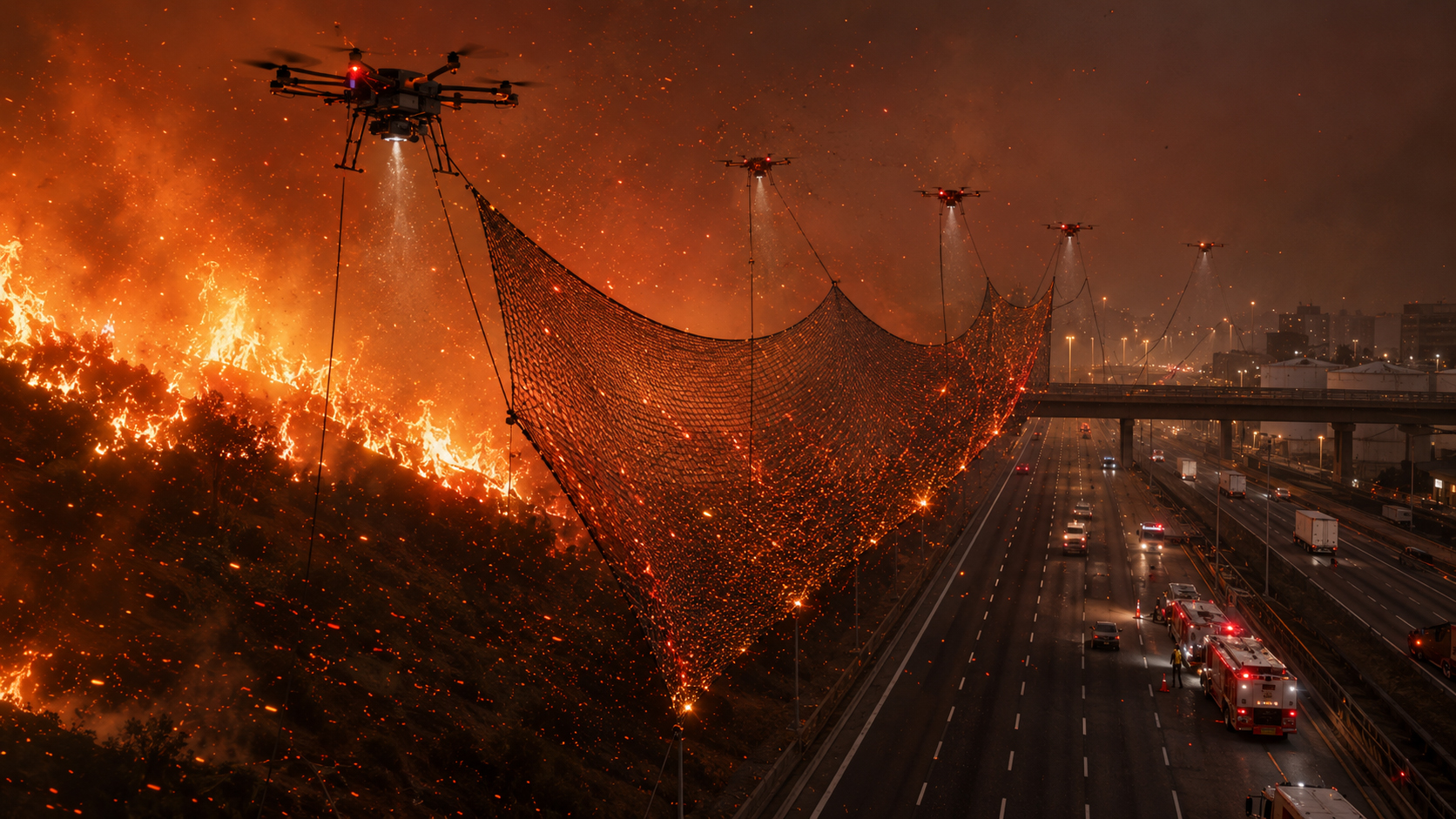
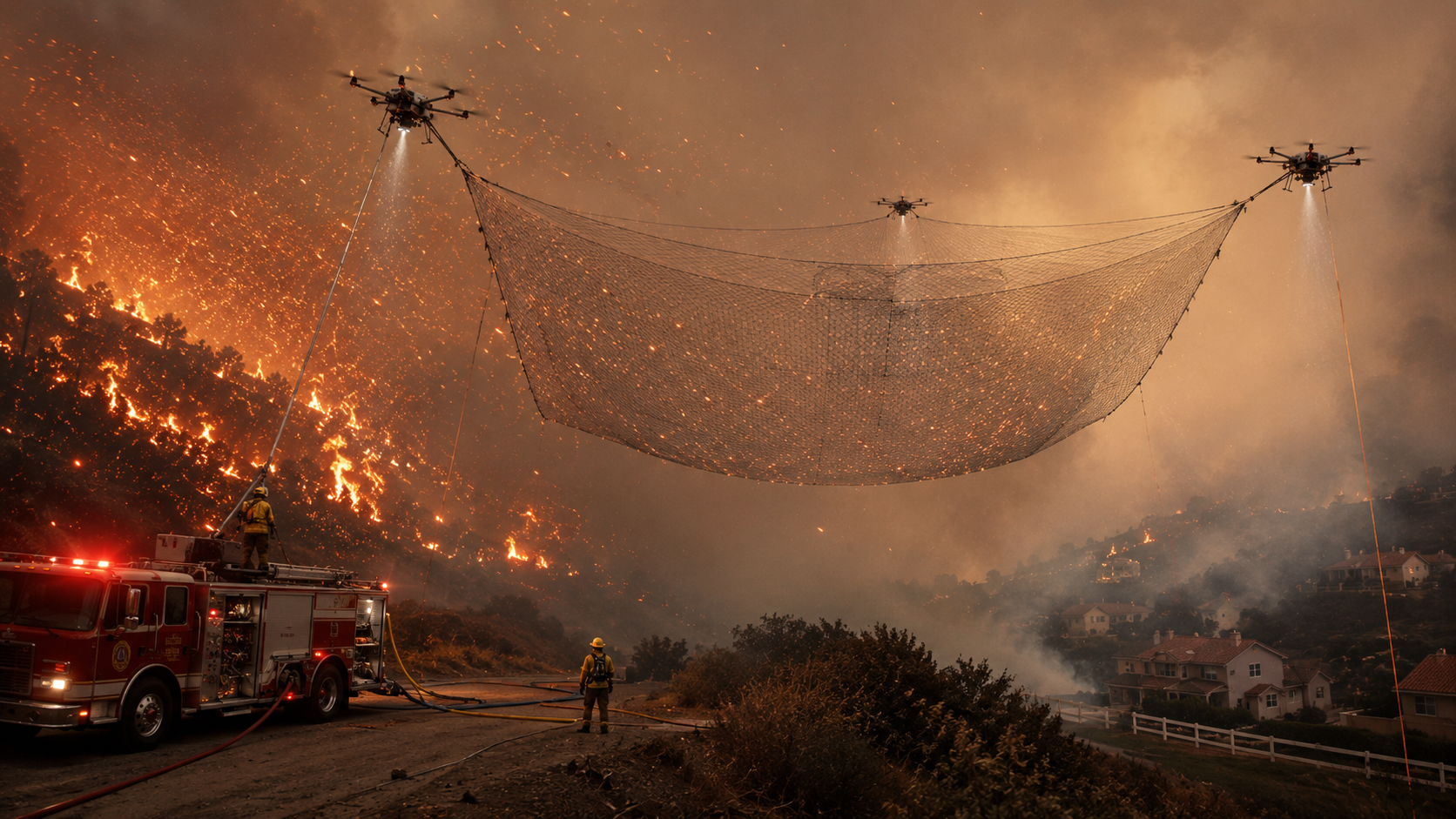
Concept image: airborne ember netting positioned between a wildfire ember source and vulnerable hillside structures.
The central opportunity is timing. After an ember lands, the problem becomes ignition
control. Before an ember lands, the problem is interception. Firenetting focuses on the
airborne moment, where a physical barrier may be able to slow, capture, or suppress embers
before they create the next fire.
The invention
FRED: First Responder Ember Drone.
FRED is the proposed operational name for the patented Firenetting system. The core concept
is a UAV-controlled fire-resistant netting system that can be deployed into the air to intercept
embers. The system may use one or more UAVs, mesh netting, tethers, sensors, power systems,
ground support, and optional water or fire-retardant delivery.
The basic operating idea is simple enough to explain in one sentence: place fire-resistant
mesh netting in the path of windborne embers and use UAVs to position, support, and control
that netting.
Core system elements
Fire-resistant mesh netting: netting intended to capture or slow embers while allowing wind to pass through.
Battery-powered UAVs: drones that can hold, position, maneuver, or guide the netting.
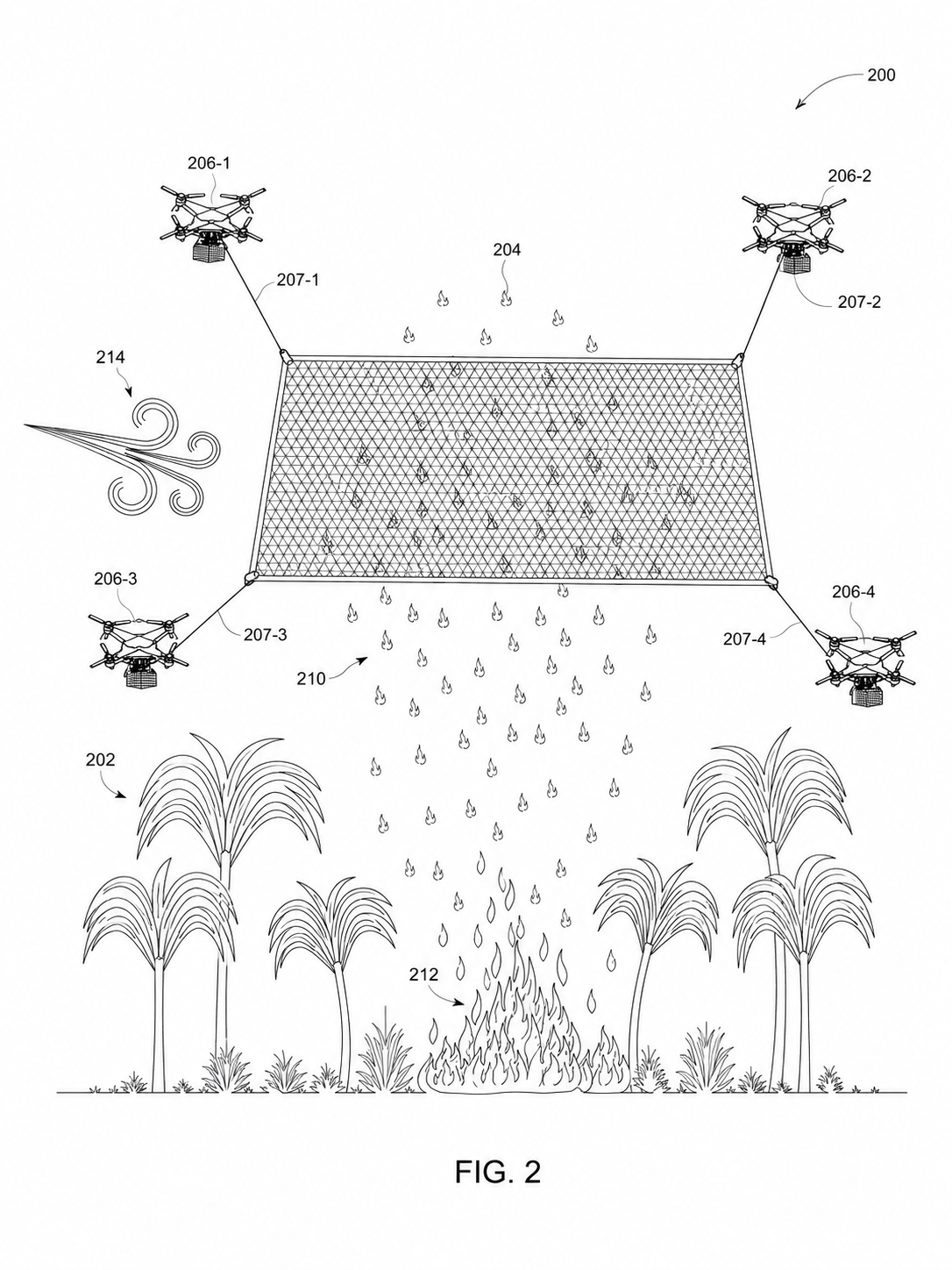
Deployment geometry: single-UAV, multi-UAV, tethered, fire-truck-supported, and road/firebreak configurations.
Sensing and control: wind, heat, ember-source, positioning, or imaging inputs to support net placement.
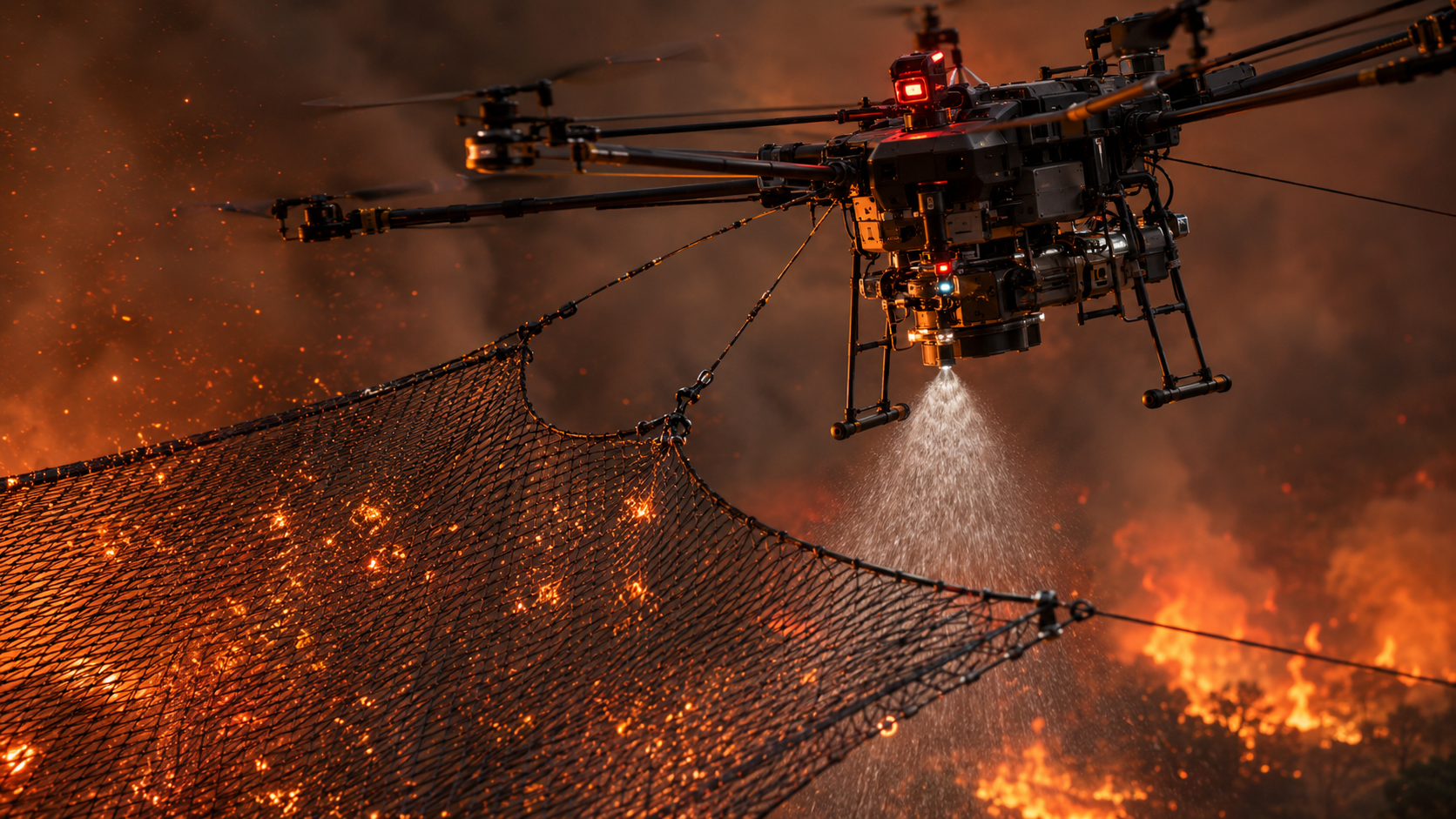
Suppression support: optional water or fire-retardant spray directed at embers captured in the mesh.
Ground support: anchors, fire trucks, power lines, hose lines, command systems, and safety standoff zones.
Concept image: UAV-supported mesh netting with suppression applied at the net.Patent position
U.S. Patent No. 12,539,435 B2.
The Firenetting concept is protected by U.S. Patent No. 12,539,435 B2,
issued February 3, 2026, for “Unmanned Aerial Vehicle (UAV) Controlled Netting
System and Method Thereof.” The inventor is Bradley Lawrence Bartz.
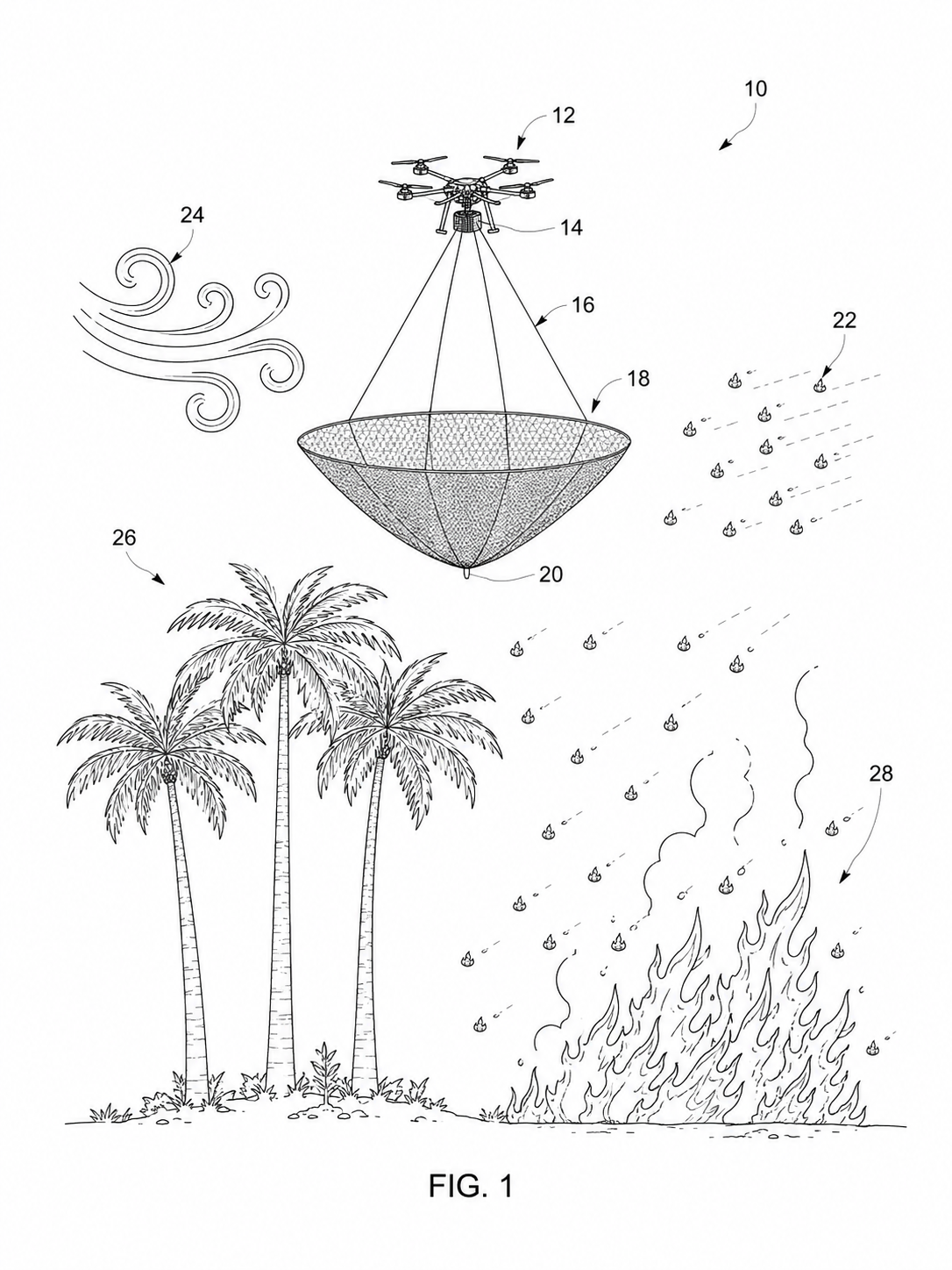
The patent describes a UAV-controlled netting system including fire-resistant mesh netting
and a battery-powered UAV configured to maintain the netting aloft and position the mesh
to capture embers based on wind conditions and ember sources. The patent also describes
optional water or fire-retardant chemical delivery and multiple operating configurations.
Open the patent PDF.
The patent establishes the protected invention territory. The next stage is engineering
validation, testing, and practical deployment planning.
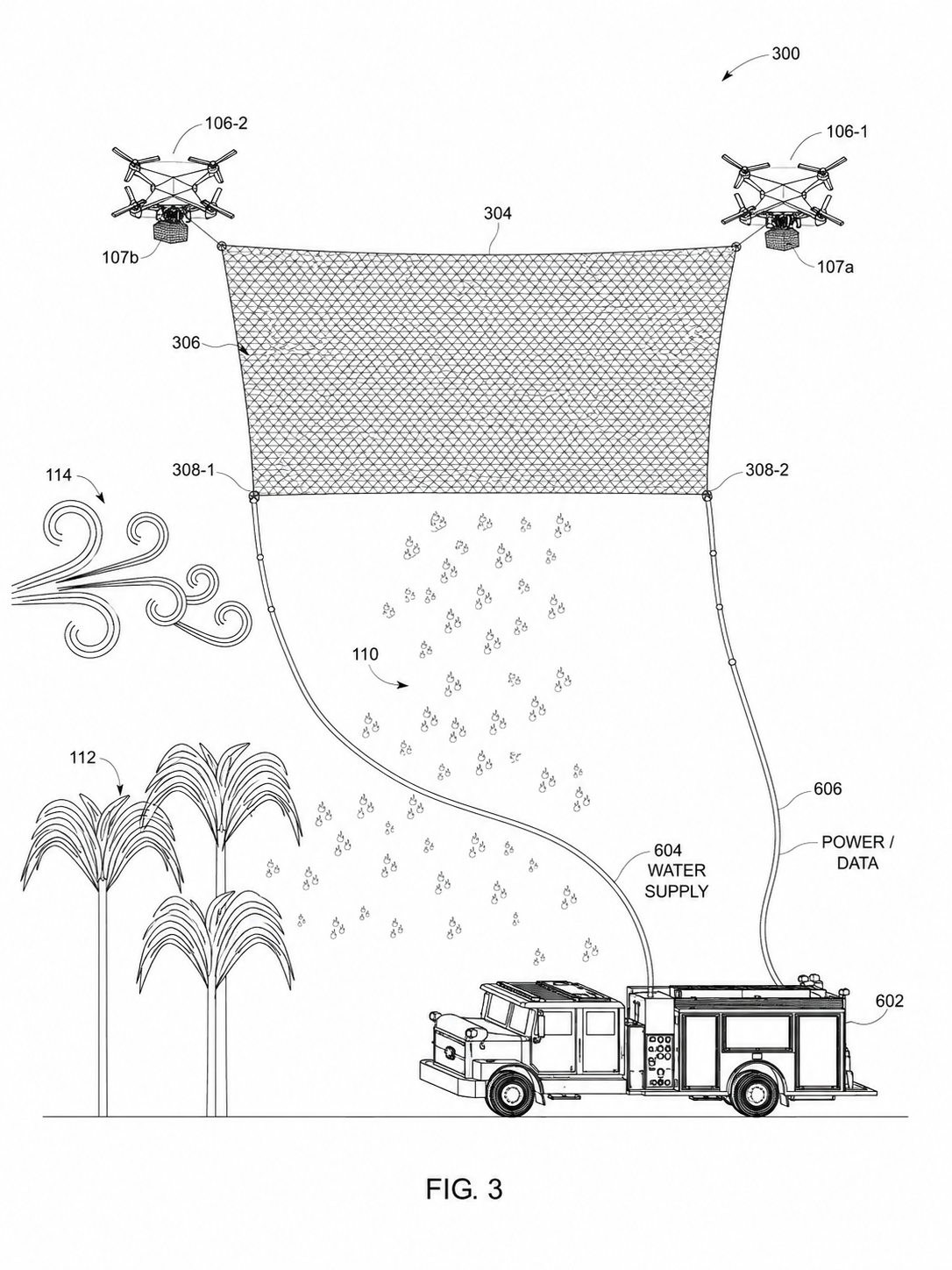
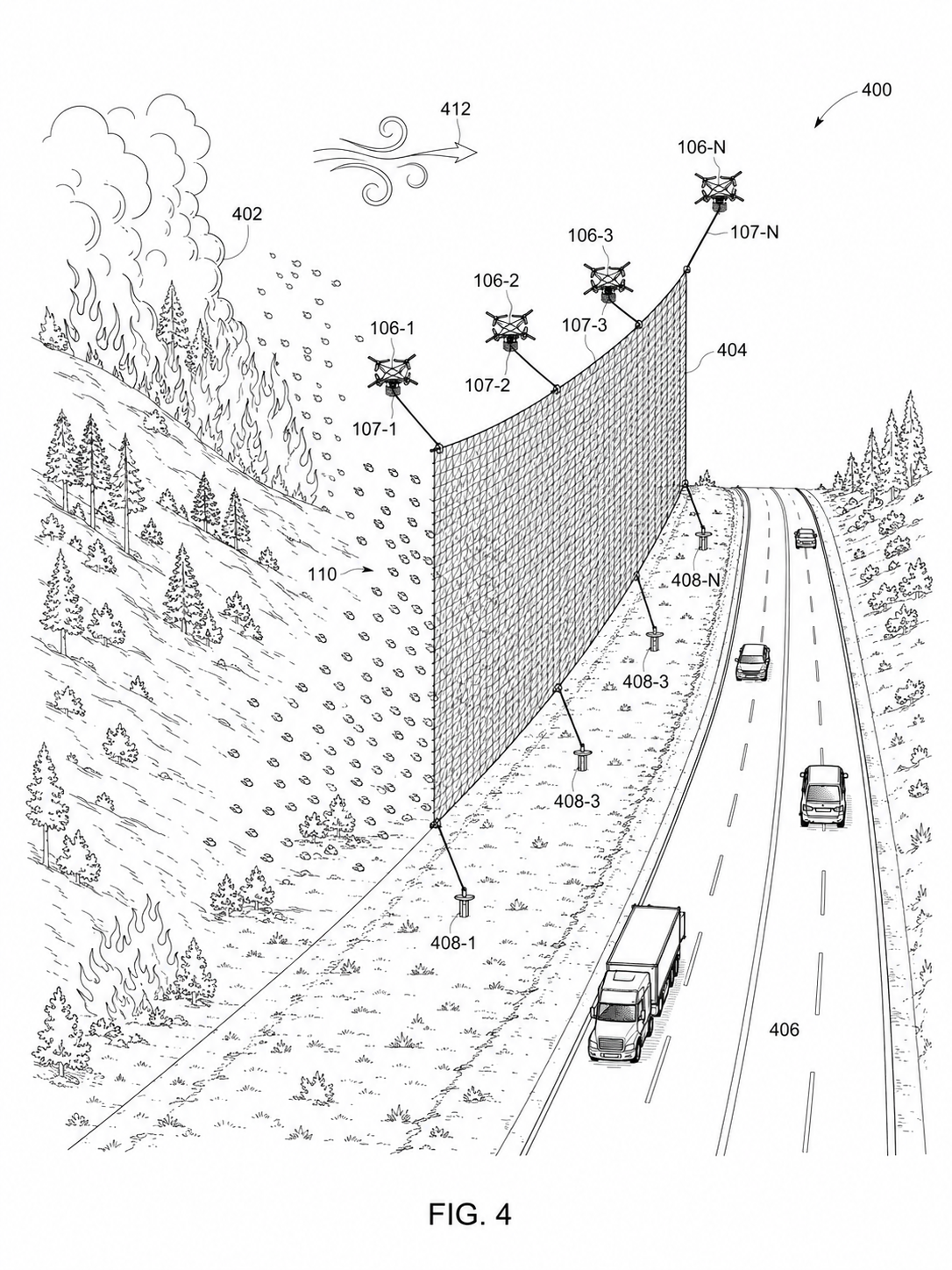
Single-UAV parachute-style ember net.Four-UAV rectangular ember barrier.Fire-truck-supported power and water.Roadway and firebreak ember barrier.
Why current tools are not enough
Firenetting is a new layer, not a replacement.
Firefighters, aircraft crews, emergency managers, and utility responders already operate
under extreme conditions. Firenetting is not proposed as a replacement for existing wildfire
suppression. It is proposed as a possible additional layer that addresses a gap: airborne ember
movement before ignition.
Existing tools remain essential
Ground crews protect people, structures, and fire lines.
Aircraft deliver water or retardant where conditions permit.
Defensible space and structure hardening reduce vulnerability.
Utilities, public works agencies, and emergency managers protect infrastructure and access.
The remaining gap
None of those measures fully solves the problem of embers traveling through the air ahead of
the fire. Firenetting is aimed at this gap. The goal is not to make broad claims before testing.
The goal is to create a disciplined engineering program that can determine whether airborne
ember interception can reduce risk in specific scenarios.
Deployment scenarios
Start where the use case is measurable.
A successful first prototype does not need to solve every wildfire problem. It should focus on
a measurable scenario where the technology can be tested safely and where results can be
documented clearly.
Scenario 1: Roadway and firebreak protection
Roads and firebreaks already serve as natural boundaries. Firenetting may add an airborne
layer to help prevent embers from jumping the corridor. This use case has strong testing value
because the geometry is understandable: fire on one side, protected corridor on the other, net
barrier in between.
Concept image: drone-supported ember netting along a freeway or firebreak corridor.
Scenario 2: Property perimeter defense
Hillside homes, ranches, resorts, critical facilities, and isolated structures may be threatened
by ember exposure before the main fire reaches the property. Firenetting could be studied as
a temporary airborne barrier between ember sources and vulnerable structure zones.
Scenario 3: Palm-tree and vertical fuel hazards
Palm trees and similar vertical fuels can release dangerous burning material. A targeted net
system may be studied around or near known ember-source hazards.
Scenario 4: Utility and infrastructure corridors
Substations, access roads, utility corridors, and emergency routes may benefit from an
airborne ember-interception layer if testing proves useful performance.
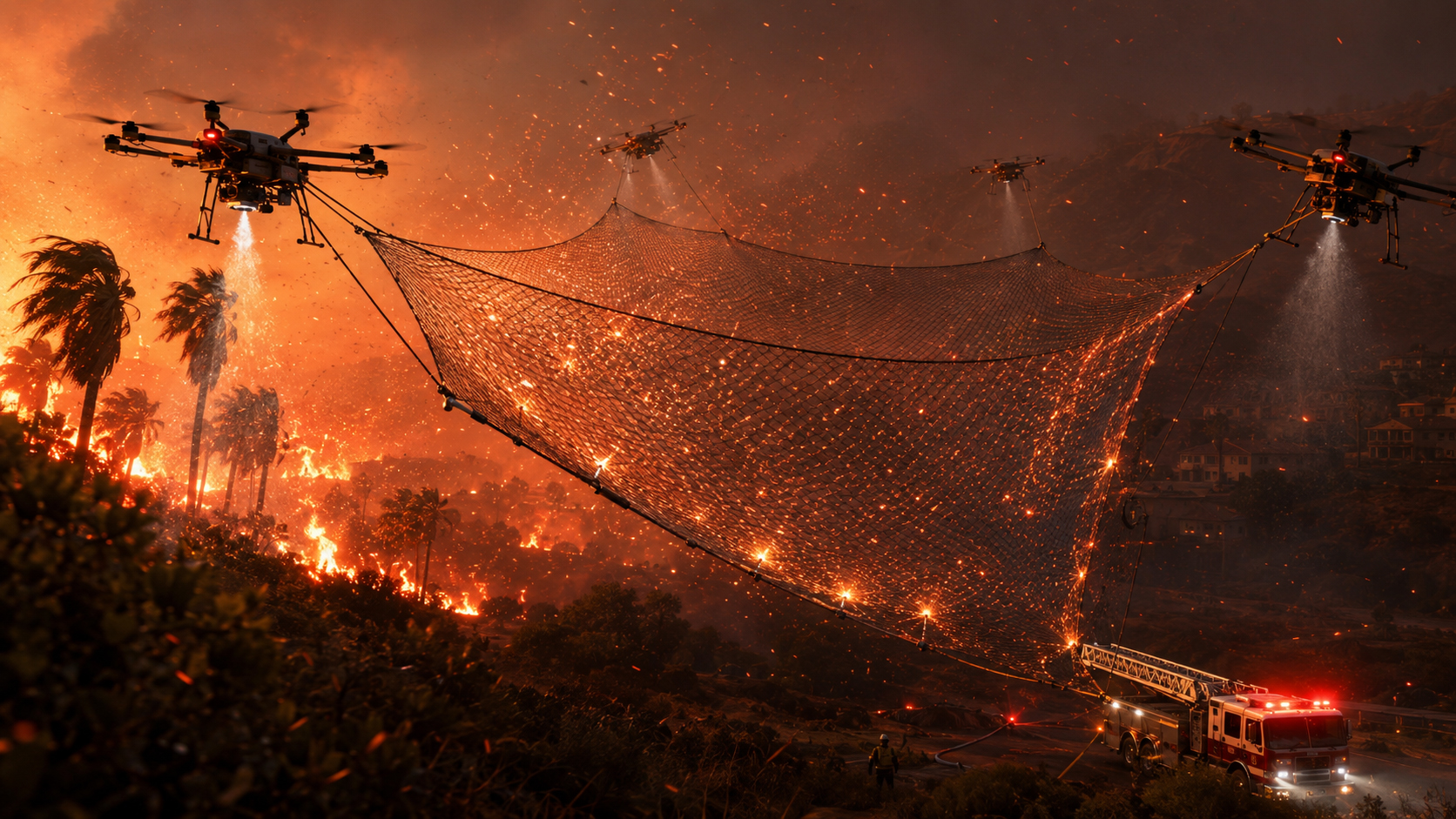
A fire truck or ground vehicle may provide anchoring, power, water, fire-retardant supply,
command support, and retrieval capability. This may reduce battery limitations and improve
operational control during stationary deployments.
Concept image: fire-truck-supported tethered drone net deployment with ground power and water support.Prototype and testing plan
Build, test, measure, then scale.
The responsible development path should move in phases. The program should begin with
modeling and controlled small-scale tests, then progress to controlled fire-lab testing, then
to agency-observed field demonstrations.
Engineering study: define mesh material candidates, porosity ranges, wind-load
models, ember-size assumptions, UAV lift requirements, tethered power configurations,
suppression delivery options, and safety protocols.
Small-scale prototype: fabricate a manageable mesh panel and test it in controlled
fan conditions using safe ember analogs or controlled particle tests. Measure capture behavior,
airflow, stability, tether loads, and handling requirements.
Controlled fire-lab testing: expose selected mesh materials and configurations
to controlled ember and heat conditions. Evaluate fire resistance, ember capture, cooling,
spray behavior, and post-capture ember risk.
Agency-observed field demonstration: conduct a realistic but controlled test with
public-safety observers, technical instrumentation, a defined test objective, and written
safety procedures.
Required test outputs
Mesh porosity recommendation.
Measured wind-load data.
Capture-rate observations.
Drone lift and stability requirements.
Tethered versus battery-only operating assessment.
Spray suppression test results.
Safety procedure draft.
Recommendation for next-stage prototype scale.
Limitations and safety considerations
The first obligation is safe testing.
Firenetting is a patented concept seeking engineering validation. It should not be treated
as a deployed fire-service product until prototype performance, operating limits, and safety
requirements have been measured in controlled environments.
FAA and emergency airspace coordination would be required before any real-world deployment.
UAV operations near smoke, heat, wind, terrain, power lines, aircraft, vehicles, and crews require strict safety protocols.
Net wind loading must be measured before useful operating limits can be claimed.
Captured embers must be cooled, contained, or safely released after interception.
Fire-resistant net materials must be tested for heat exposure, ember retention, structural strength, and degradation.
Tethered power, hose lines, anchors, and command systems must be evaluated for trip hazards, entanglement risk, and emergency retrieval.
Firenetting should first be tested in controlled environments before any wildfire deployment is considered.
This white paper proposes a disciplined engineering pathway. The technology should earn its
credibility through simulation, prototype testing, fire-lab review, safety documentation, and
agency-observed demonstrations.
Research questions
The grant should answer hard questions.
A strong funding program should not assume the outcome. It should create the evidence
needed to determine where the invention is practical, where it is not, and what engineering
improvements are required.
Research Question
Why It Matters
Possible Measurement
What mesh porosity captures dangerous embers without becoming an uncontrollable sail?
Determines the basic net design and operating range.
Airflow, wind load, capture behavior, net deformation.
What UAV lift capacity is required for useful net sizes?
Determines drone platform feasibility and cost.
Payload, tether tension, flight stability, power draw.
Can tethered power safely extend useful operating time?
Determines whether stationary defense is more practical than battery-only flight.
The following ranges are preliminary planning estimates intended to support grant, investor,
and partner conversations. Final budgets should be refined after engineering scoping, partner
selection, UAV platform review, test-site planning, and safety review.
Phase
Purpose
Estimated Budget
Phase 1
Engineering study, simulation, safety review, material evaluation, prototype specifications.
$75,000–$150,000
Phase 2
Small-scale prototype, wind/fan testing, safe ember analog testing, capture-rate measurement.
Firenetting should be developed with partners who can help define, test, measure, and
safely evaluate the technology. The first partnership should not be based on hype. It should
be based on disciplined testing.
Built by a field-energy inventor, not a theory shop.
Bradley Bartz is the inventor of FRED and founder of
ABC Solar Incorporated. His background brings decades of practical solar,
battery, backup power, field installation, and emergency-resilience experience into the
wildfire technology problem.
Firenetting is rooted in practical deployment questions: how power is supplied, how equipment
is installed, how systems behave in the field, how emergency responders might use the system,
and how a concept moves from drawing to working prototype.
The project is seeking partners who understand that the gap between a patent and a public-safety
tool is engineering evidence. The goal is not to overclaim. The goal is to test.
Commercialization pathway
From patent to prototype to licensed deployment.
The most likely commercialization pathway is staged. The first stage is not mass production.
The first stage is engineering validation. Once useful test data exists, Firenetting can evaluate
licensing, joint development, manufacturing partnerships, government procurement pathways,
and specialized deployment services.
Possible commercialization models
Licensing: license the patented concept to drone, fire-equipment, or defense contractors.
Joint development: work with a UAV platform partner and fire-resistant material supplier.
Agency demonstration program: build a prototype system for observed public-safety testing.
Utility corridor protection: develop specialized systems for infrastructure and access routes.
Insurance-backed risk reduction: study neighborhood-scale or property-scale ember defense.
Conclusion
The patent exists. The need is urgent. The next step is evidence.
Firenetting does not claim to replace firefighters, aircraft, defensible space, structure
hardening, or existing wildfire suppression methods. It proposes a new layer: airborne ember
interception.
The invention is protected. The concept is clear. The test questions are knowable. The budget
can be staged. The first use cases can be narrowed. The responsible next step is to build,
test, measure, and determine where this technology can help protect lives, property, and
infrastructure.
Immediate ask: Firenetting seeks grant funders, strategic investors, engineering
partners, drone-platform partners, wildfire researchers, fire-agency observers, utility partners,
insurers, and public-safety collaborators for prototype development and controlled testing.
Firenetting is ready for grant, investor, engineering, drone-platform, research,
and public-safety conversations focused on prototype development and controlled testing.